A 70-degree Hopkins rod examination is a transoral rigid laryngoscopy, not the same test as a flexible scope passed through the nose. Before you book, you will be able to match the examination to your symptoms, understand the preparation and aftercare, and ask whether the clinic is equipped for your needs or your child’s.
Key takeaways
- Hoarseness lasting over three to four weeks needs laryngeal visualisation.
- Rigid Hopkins rod laryngoscopy gives a bright, magnified oral view of the larynx.
- Flexible nasolaryngoscopy passes through the nose and suits different examination needs.
- Ask a child’s clinic about equipment, pediatric experience, comfort and aftercare.
When do you need a 70-degree Hopkins rod laryngoscopy?
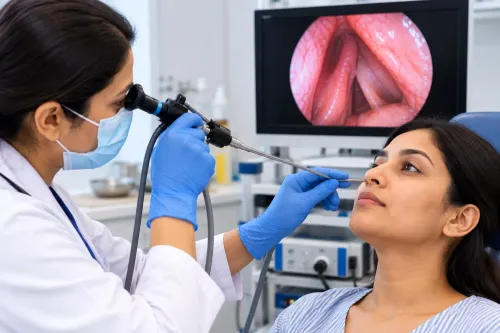
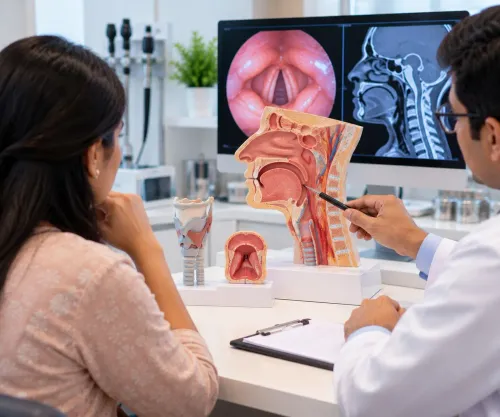
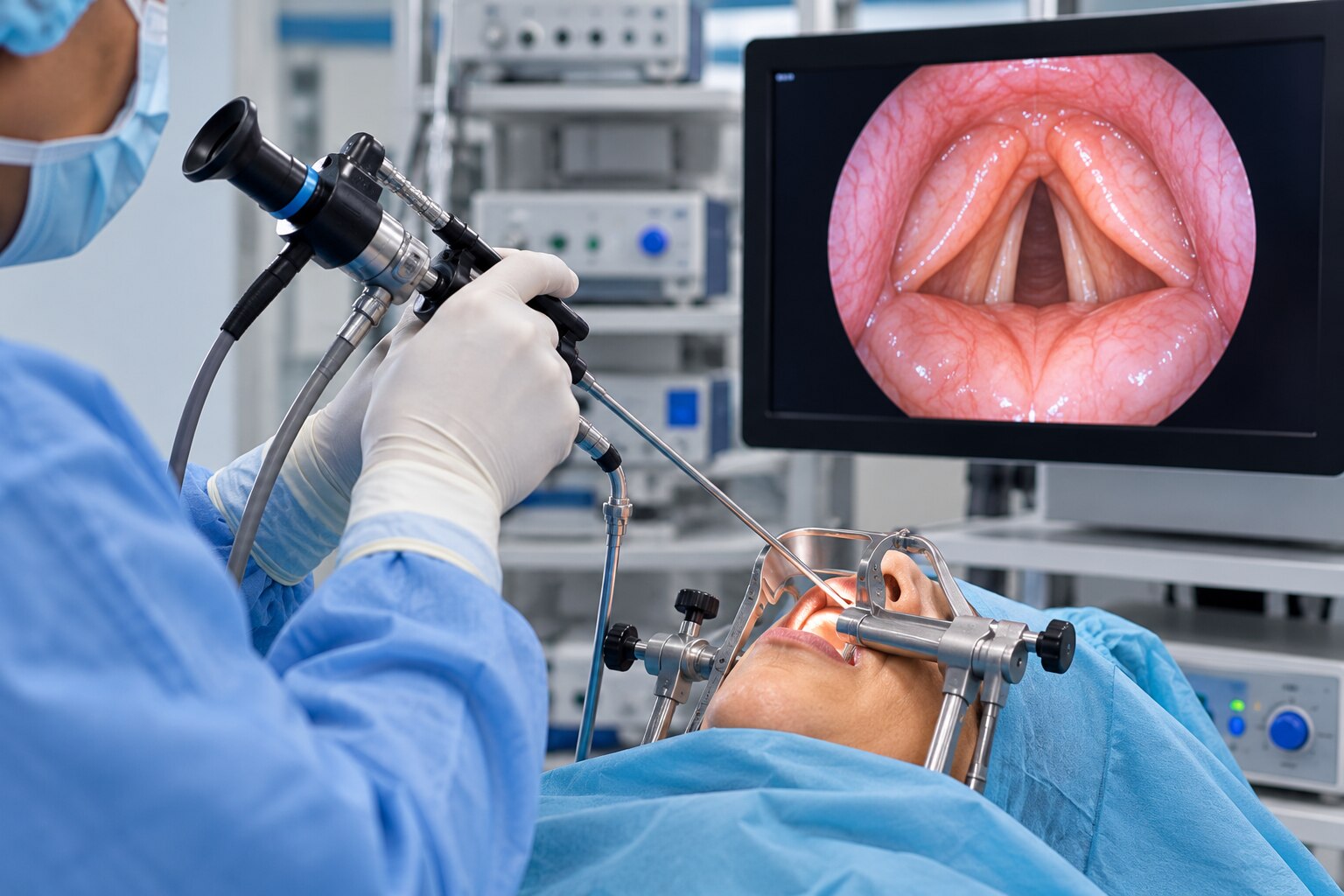
Hoarseness lasting more than three to four weeks justifies visualising the larynx rather than treating presumed reflux or allergy indefinitely. A 70-degree Hopkins rod passes over the tongue through the mouth and gives a bright, magnified view of the base of tongue, vallecula, epiglottis, arytenoids, false vocal folds, true vocal folds and nearby hypopharynx.
If you want to book larynx examination in Bangalore, confirm that the appointment includes this transoral rigid technique.
Ask for assessment when you have:
- Voice fatigue or hoarseness that persists beyond three to four weeks
- Throat pain, painful swallowing or difficulty swallowing
- Coughing or choking during meals
- Coughing blood, unexplained noisy breathing or a neck mass
- A suspected vocal-cord lesion, such as a polyp, nodule or ulcer
Arrange earlier assessment after tobacco exposure, or if you have respiratory distress, recent intubation, recent head-and-neck surgery or a neck mass. Breathing difficulty requires urgent medical attention.
| Finding or concern | What the examination can show | What it cannot establish alone |
|---|---|---|
| Persistent hoarseness | Vocal-fold redness, swelling, lesions or movement changes | Whether a biopsy, stroboscopy or imaging is needed |
| Swallowing symptoms | Visible structures from the tongue base to nearby hypopharynx | The cause of every swallowing disorder |
| A suspicious lesion | Its location and surface appearance | A definite diagnosis without tissue sampling |
Laryngoscopy is an examination, not automatically a biopsy or complete diagnosis. A normal view does not exclude disease outside the visualised field or an intermittent movement problem.
How does a rigid Hopkins rod compare with flexible nasolaryngoscopy?
The better route depends on what the clinician needs to see and how comfortably you can tolerate the examination. A 70-degree Hopkins rod is a mouth-held, transoral telescope; flexible nasolaryngoscopy uses a flexible scope passed through the nose.
| Option | Viewing method | Main advantage | Main limitation |
|---|---|---|---|
| 70-degree Hopkins rod | Angled rigid telescope over the tongue | Bright, detailed, magnified view of the larynx and nearby hypopharynx | More tongue pressure and gagging |
| Flexible nasolaryngoscopy | Flexible scope through the nose | Usually less gagging; observes the larynx during breathing, speaking and connected voice use | Nasal discomfort or blockage can limit the examination |
The rigid examination can be difficult with a strong gag reflex, limited mouth opening, dental problems or significant anxiety. The flexible examination avoids the mouth route, but nasal anaesthetic, passage through a narrow nostril or a blocked nose can make it uncomfortable and reduce visibility.
Confirm the exact technique before booking. A clinic advertising “laryngoscopy” may offer only flexible nasal endoscopy, not a transoral 70-degree examination. If you are searching for 70-degree Hopkins rod laryngoscopy in Bangalore, ask which scope will be used and whether the examination is performed while you are awake.
The instrument name does not decide the best first test. Stroboscopy can assess vocal-fold vibration; imaging can examine areas outside the view; biopsy can identify tissue disease; and swallowing assessment can investigate coughing or choking with meals.
What happens during the appointment, and how should you prepare?
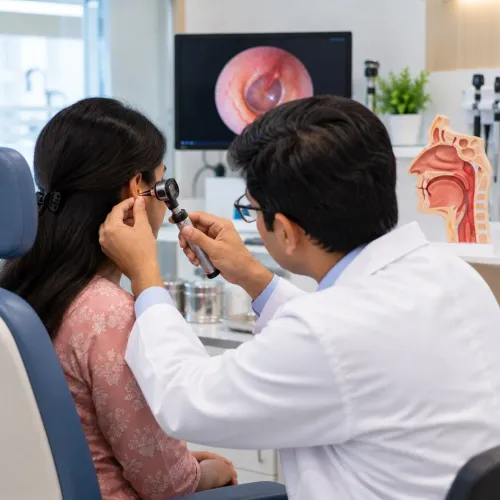
At a laryngoscopy appointment in Bangalore, the clinician first reviews your symptoms, medical history and voice, then examines your mouth, nose and throat. Tell them about medicine allergies, warfarin or apixaban, aspirin or clopidogrel, bleeding disorders, pregnancy, serious heart or lung disease, previous difficult airway management and current breathing difficulty.
The examination usually follows this sequence: preparation of the nose or mouth; sitting upright with your head positioned; placement of the 70-degree scope over the tongue; inspection while you breathe, speak and make specific sounds; removal of the instrument; and discussion of the findings.
Local anaesthetic may be sprayed or applied to the nose, tongue or throat. Numbness does not guarantee that gagging will stop.
| Routine outpatient examination | Awake, mouth-held rigid scope; topical anaesthetic may be used | Viewing the larynx in the clinic |
|---|---|---|
| Direct laryngoscopy | General anaesthesia in an operating theatre | Palpation, biopsy, lesion or foreign-body removal, or a more complete examination |
| Biopsy planning | Procedure-specific bleeding and medicine review | Particularly important with warfarin, apixaban, aspirin or clopidogrel |
Follow the clinic’s eating and drinking instructions. Ask before booking whether you should eat beforehand, and do not eat or drink until normal throat sensation and protective swallowing return; a numb throat weakens protective swallowing and increases choking risk. If biopsy is being considered, confirm how anticoagulants or antiplatelet medicines will be managed.
A routine examination and direct laryngoscopy are different appointments, so confirm which one is planned.
How do you choose a laryngoscopy clinic for a child in Bangalore?
A child can have laryngeal assessment, but a 70-degree rigid scope is not automatically the best first test. A small oral cavity, limited cooperation, strong gag reflex or particular airway anatomy can make a mouth-held telescope difficult.
| Option | What it involves | When it may fit |
|---|---|---|
| Awake flexible nasolaryngoscopy | A flexible scope passes through the nose while the child breathes and speaks | When cooperation is possible and avoiding oral gagging matters |
| Transoral 70-degree Hopkins rod | An angled rigid telescope passes over the tongue through the mouth | When the child can tolerate the instrument and a detailed angled view is needed |
| Examination under anaesthesia | Assessment in a controlled theatre setting | When cooperation is poor or palpation, biopsy, lesion removal or a complete airway assessment is required |
A laryngoscopy clinic for children in Bangalore should answer these questions before you book:
- Does the clinician routinely examine children?
- Is awake flexible nasolaryngoscopy available?
- Should the child fast, and what are the sedation instructions?
- Are paediatric anaesthesia and airway support available if examination under anaesthesia becomes necessary?
When contacting Dr. Sohini's ENT Care - Empathy meets Expertise, ask whether the appointment is a transoral 70-degree Hopkins rod examination or a flexible nasal examination, who will perform it, and whether your child’s symptoms require a different setting.
If you want to book laryngoscopy with 70 degree Hopkins rod in Bangalore, confirm the technique rather than relying on the word “laryngoscopy” alone.
Related service
OPD Consultation and Procedures Laryngoscopy with 70° Hopkins Rod Explore advanced laryngeal care with Dr. Sohini Chakrabarti's expertise in Laryngology, featuring the cutting-edge 70° Hopkins Rod technology. View service → |
How long does laryngoscopy take, and what happens afterward?
The appointment may take different lengths because the clinician must review your history, prepare the throat, manage gagging, ask you to perform voice tasks, and decide whether additional tests are needed. Ask the clinic for its expected appointment duration; do not assume every laryngoscopy is a same-day procedure.
- After a routine outpatient examination, plan to return to work or school once you feel comfortable. Throat numbness, coughing, irritation or temporary hoarseness can make speaking and eating unpleasant.
- Follow the clinic’s instructions about food and drink. Do not eat or drink until normal throat sensation and protective swallowing have returned, because numbness increases choking risk.
- Arrange an accompanying adult if sedation is planned, you feel faint or very anxious, or the clinic requests one. A simple topical anaesthetic alone does not always require an escort.
A normal-looking larynx does not exclude intermittent vocal-fold movement problems, swallowing disorders, reflux-related symptoms or disease outside the visualised field. You may still need stroboscopy, imaging, tissue sampling or speech-language assessment.
Mild gagging, irritation, coughing or short-lived hoarseness can occur after the test. Seek urgent medical advice for increasing breathing difficulty, significant bleeding, inability to swallow or worsening pain.
Frequently asked questions
When do you need a 70-degree Hopkins rod laryngoscopy?
It is used to examine the larynx when hoarseness lasts over three to four weeks or when the clinician needs a detailed view of the vocal folds and nearby structures.
How does rigid Hopkins rod laryngoscopy compare with flexible nasolaryngoscopy?
A rigid 70-degree Hopkins rod enters through the mouth and provides a bright, magnified view. Flexible nasolaryngoscopy passes through the nose and can assess the throat during breathing and speech.
How should you prepare for a laryngoscopy appointment in Bangalore?
Confirm whether you should avoid food or drink, bring previous reports and medication details, and tell the clinic about gag reflex, nasal blockage, allergies or relevant medical conditions.
How long does laryngoscopy take, and what happens afterward?
The examination is usually brief, but the clinic should explain the exact timing. Afterward, follow instructions about eating, drinking and reporting persistent pain, bleeding or breathing difficulty.
Keywords