
A bead, food fragment, toy part or button battery needs a different response depending on whether it is in the outer ear canal, nasal passage, food pipe or airway. You will learn how to recognise the location, what to do before care, how clinicians remove the object and which warning signs make the situation an emergency.
Key takeaways
- Never probe with cotton buds, tweezers or water at home.
- Treat button batteries and swallowed magnets as emergencies.
- Call emergency services for choking, breathing difficulty or blue lips.
- Arrange pediatric ENT care after removal for bleeding, pain or discharge.
Which objects get stuck, and how can you tell where they are?
Beads, toy parts, paper, cotton buds and small food pieces are common foreign objects. Button batteries and magnets are more dangerous: a button battery in the ear or nose can burn tissue within a short time, while magnets can cause serious injury if swallowed.
The warning signs depend on the site:
| Location | Clues you may notice | Urgency |
|---|---|---|
| Ear | Sudden pain, reduced hearing, bleeding, discharge, foul smell or repeated touching of the ear | Arrange prompt ENT assessment; never probe it |
| Nose | One-sided blockage, foul-smelling or bloody discharge, nosebleed, noisy breathing or the child saying something is lodged there | Arrange prompt assessment; a button battery is an emergency |
| Throat or food pipe | Drooling, inability to swallow liquids or saliva, gagging or pain when swallowing | Seek emergency assessment |
| Airway | Choking, sudden persistent cough, stridor, breathing difficulty or blue lips or face | Give emergency first aid and call 112 |
An object stuck in childs ear often causes obvious discomfort, but a child may only keep rubbing that side. An object stuck in childs nose can remain unnoticed until one-sided, foul-smelling discharge appears.
Do not sweep the throat with a finger or make repeated blind attempts to remove an object; these actions can push it deeper. A choking child or one who cannot breathe needs emergency care, not a routine pediatric ENT emergency in Bangalore.
What should you do before a child is examined?
Keep the child calm and stop them from putting fingers, cotton buds or another object into the ear or nose. If the child is choking, cannot breathe, turns blue, or cannot speak or cry, give age-appropriate choking first aid and call 112 immediately.
- If breathing is normal, arrange prompt medical assessment and keep the child supervised. Searching for “object stuck in childs ear” or “object stuck in childs nose” should lead you to professional care, not home extraction.
- Do not probe an ear with cotton buds, hairpins, matchsticks or household tweezers. A failed attempt can push the object deeper, tear the ear canal or damage the eardrum.
- Do not make repeated blind attempts in the nose, forcefully blow the nose, or use fingers. These actions can push an object backward and trigger bleeding.
- Do not pour water or oil into the ear. Irrigation is unsafe for a soft or absorbent object, button battery, vegetable matter, ear tubes, a possible perforated eardrum or significant canal injury.
- Treat a button battery in the nose or ear as an emergency. Take the child for immediate removal; it can cause tissue injury and nasal-septum damage within hours.
A child who is drooling, has worsening pain or bleeding, or may have inhaled an object needs the nearest emergency department with paediatric and ENT capability. Call ahead to confirm services.
How are objects removed from a child’s ear or nose?
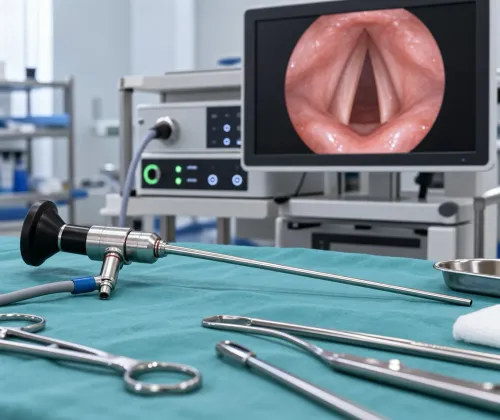
Clinicians first locate the object with an otoscope for the ear or a light and nasal speculum for the nose. They assess its size, depth, edges and contact with the eardrum or nasal lining before choosing a removal tool.
- An ear object within clear view may be lifted with small forceps, a suction tip or a delicate hook. A live insect may be immobilised with mineral oil or lidocaine before extraction, but clinicians avoid liquid when a perforated eardrum or ventilation tube is possible.
- A nasal object is usually removed under direct vision with forceps, suction or a hook. Blind probing and repeated attempts can drive it backward, tear tissue and cause bleeding.
- The clinician rechecks the ear or nose after extraction for retained pieces, abrasions, infection, bleeding or eardrum perforation. This check matters even after an insect removal because legs or other fragments can remain.
A child who cannot stay still, has a deeply wedged object, or has bleeding from an earlier attempt may need topical or local anaesthesia, procedural sedation, or removal under general anaesthesia in an operating setting. A button battery, magnet, breathing difficulty, choking, drooling or suspected inhalation requires the nearest emergency department, not a routine appointment.
Confirm pediatric and ENT capability by phone; call 112 for an emergency. For families arranging foreign body removal child in bangalore, a calm child breathing normally can be assessed by an ENT service, while severe pain, persistent bleeding or breathing changes need emergency care.
When does a throat or airway object require emergency treatment?
An object in the food pipe (oesophagus) is urgent even when a child is breathing comfortably. Drooling or inability to swallow water or saliva suggests complete blockage. An object inhaled into the airway can cause sudden choking, persistent coughing, wheezing, stridor or breathing difficulty, and requires immediate assessment.
Call 112 and seek emergency care immediately if your child has:
- Blue or grey lips, collapse, severe choking or inability to breathe
- Stridor, noisy breathing, chest retractions or rapidly worsening breathlessness
- Persistent coughing after inhaling food or a small object
- Drooling, inability to swallow saliva, or an object visibly lodged in the throat
- A suspected button battery, magnet, sharp object or unknown swallowed object
Do not sweep the throat with a finger or offer food and drink to push an object down. If the child is choking, provide age-appropriate choking first aid while calling emergency services.
A suspected airway aspiration needs hospital assessment even if coughing settles, because the object can remain in a bronchus and cause later infection or lung damage.
Take a child immediately to an emergency department with paediatric and ENT capability for any button battery or magnet ingestion. A button battery can burn through the oesophagus, while multiple magnets can trap bowel tissue and cause perforation or fistulas without early symptoms.
A battery lodged in the nose also needs immediate professional removal; it can damage the nasal septum within hours. A pediatric ENT emergency in Bangalore requires a facility with the right imaging, endoscopy and surgical support, so confirm capability by phone while travelling.
What happens after removal, and where should you seek care in Bangalore?
The clinician should confirm that the entire object is out, inspect the ear canal or nasal lining, and check the eardrum when the object was in the ear. After throat removal, the child needs assessment for scratches, swelling and safe swallowing. Keep any removed battery, magnet or sharp object for identification.
Seek follow-up for persistent pain, bleeding, foul-smelling discharge, fever, reduced hearing, one-sided nasal blockage, worsening throat pain, drooling or difficulty swallowing. Breathing difficulty, blue lips, choking, repeated vomiting or suspected aspiration needs immediate emergency care, even after the object appears to be removed.
A search for “foreign object removal child in bangalore” or “foreign body removal child in bangalore” should lead you to triage by urgency, not clinic distance.
| Option | Choose it when | What to do |
|---|---|---|
| ENT appointment | The child is breathing normally and has a routine ear or nose object | Arrange prompt assessment; do not probe the site |
| Emergency department | There is choking, breathing difficulty, drooling, suspected aspiration, a button battery, magnet, sharp object or oesophageal blockage | Go to the nearest hospital with paediatric and ENT capability; call 112 for life-threatening symptoms |
| Post-removal review | Pain, bleeding, discharge or hearing or swallowing problems continue | Contact the removing clinician or an ENT service the same day |
In Bangalore, Dr. Sohini's ENT Care - Empathy meets Expertise can help assess whether a stable ear or nasal case needs an outpatient ENT visit or escalation. Phone the facility first to confirm hours, paediatric support and emergency capability.
Related service
OPD Consultation and Procedures Foreign body removal From Ear, Nose and Throat Trust in the expert hands of Dr. Sohini Chakrabarti for precise and effective removal of foreign bodies from the Ear, Nose, and Throat (ENT). View service → |
Frequently asked questions
What should I do if an object is stuck in my child’s ear or nose?
Keep the child still and do not insert cotton buds, tweezers, fingers or water. Seek medical examination, especially for a button battery, magnet, pain, bleeding or discharge.
Why are button batteries and magnets dangerous for children?
A button battery in the ear or nose can burn tissue within a short time. Swallowed magnets can attract through bowel walls and cause serious injury, so both situations need urgent medical care.
When is a foreign object in a child’s throat an emergency?
Call emergency services immediately for choking, inability to breathe or speak, noisy breathing, blue lips, severe coughing or sudden breathing difficulty.
Where can I get foreign object removal for a child in Bangalore?
Contact a pediatric ENT service in Bangalore for an examination and removal. Choose emergency care immediately when the child has breathing trouble or swallowed a battery or magnet.
Keywords