
The right choice depends on whether hearing loss comes from a removable ear problem, damage in the inner ear, or a combination of both. By the end, you will know which tests come first, when hearing aids are suitable, and when medical treatment, surgery, bone-conduction devices, or cochlear implant evaluation deserves priority.
Key takeaways
- Hearing aids amplify sound but do not treat every cause of hearing loss.
- A hearing evaluation identifies type, severity, pattern, and possible causes.
- Choose hearing aid style, features, and fitting after testing—not by price alone.
- Rehabilitation includes fitting adjustments, listening practice, and follow-up care.
Deafness management or hearing aids: which treats the actual problem?
A hearing aid makes sound louder; it does not repair the cause of hearing loss. Deafness management is the broader plan: identify the type, degree, cause, duration, and one-sided or two-sided pattern, then choose medical treatment, surgery, amplification, rehabilitation, or a combination.
| Hearing loss | What affects hearing | Usual priority |
|---|---|---|
| Conductive | Outer or middle ear, such as wax, a foreign body, infection, fluid, eardrum damage, or another middle-ear problem | Remove the blockage or treat the disease first; surgery may correct a structural problem. Use a hearing aid when loss remains or treatment cannot restore hearing. |
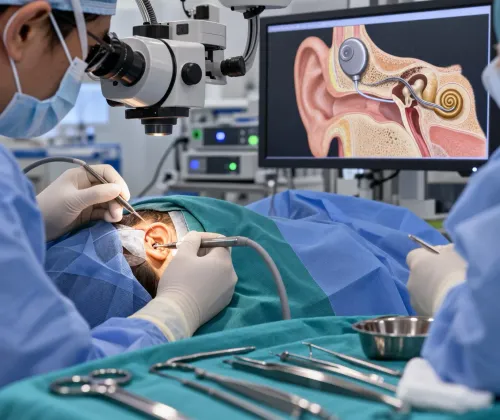
| Sensorineural | Cochlea or auditory nerve | Permanent adult loss is usually managed with hearing aids, communication training, assistive listening devices, or rehabilitation. Selected severe-to-profound cases need cochlear implant assessment. |
| Mixed | Conductive and sensorineural components together | Treat the outer or middle-ear component and use amplification for the remaining inner-ear loss. |
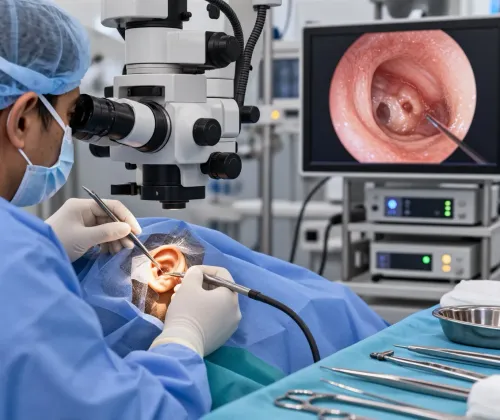
Medical or surgical treatment comes before device fitting when wax, a foreign body, active infection, fluid, pain, discharge, or an eardrum or middle-ear disorder is present. Hearing aids can be fitted after examination confirms aidable loss, including permanent sensorineural loss.
A device and treatment are both needed when a reversible conductive problem coexists with permanent cochlear damage.
For deafness management or hearing aids in Bangalore, start with an ENT examination and audiologist assessment rather than buying amplification. These deafness treatment options in Bangalore depend on the findings—not the label “deafness” alone. Sudden one-sided loss developing over hours or a few days needs urgent ENT assessment, not a delayed hearing-aid appointment.
What happens during a hearing evaluation in Bangalore?
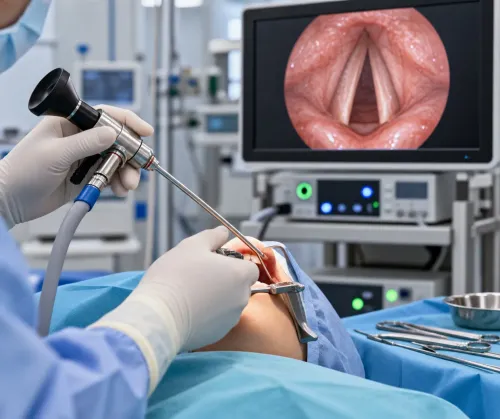
Your first appointment for hearing loss management in Bangalore should be an ENT examination, not a hearing-aid purchase. The ENT uses otoscopy to inspect the ear canal and eardrum, then an audiologist measures hearing. Tympanometry checks eardrum movement and middle-ear pressure when wax, fluid, blockage, or other middle-ear disease is suspected.
| Test | What it measures | What it shows |
|---|---|---|
| Pure-tone audiometry | Air- and bone-conduction thresholds in decibels | The degree and pattern of hearing loss |
| Speech audiometry | Speech detection and speech recognition | How well you detect and understand speech |
| Tympanometry | Eardrum movement and middle-ear pressure | Possible fluid, blockage, or middle-ear disease |
On an audiogram, air conduction reflects the full hearing pathway from the outer ear to the auditory nerve. Bone conduction bypasses the outer and middle ear and helps identify the inner-ear component. A gap between air and bone thresholds suggests conductive involvement.
Speech recognition is the percentage of words you repeat correctly at a comfortable listening level.
Ask why additional testing or ENT investigation is needed if you have:
- A large difference between ears or rapidly changing thresholds
- Tinnitus, vertigo, ear discharge, or ear pain
- Significant noise exposure or exposure to medicines linked to hearing damage
- A family history of hearing loss
These findings can point to a treatable ear problem or a condition that needs more than routine amplification.
Which hearing aid design and fitting is right for you?
A hearing aid should be chosen from your audiogram, not from its size or advertised features. For deafness management or hearing aids in Bangalore, compare these designs against your hearing loss, ear health, dexterity, vision, budget, and willingness to clean, charge, and wear the device.
| Design | Visibility and handling | Power, fit and maintenance |
|---|---|---|
| Behind-the-ear | Visible behind the ear; easiest to handle | Strong output; uses an earmould or tubing; easier repair access; protect it from moisture |
| Receiver-in-canal | Small case behind the ear; manageable for most users | Natural sound and moderate-to-high power; receiver sits in the canal; wax and moisture can damage it |
| In-the-ear | Fills part of the outer ear; easier to insert than tiny canal aids | Custom ear-canal fit; moderate-to-high power; repair access is less convenient |
| Completely-in-canal | Least visible; difficult for limited dexterity or vision | Lower power; deeper canal fit; more exposed to wax and moisture; repairs require removal |
Rechargeable models avoid daily battery changes but need reliable charging and cost more upfront; disposable batteries suit users without charging access. Basic amplification may be enough in quiet settings. Noise reduction, directional microphones, feedback control, and Bluetooth help with speech, whistling, and phone or television use, but they do not replace correct programming.
Compare two aids when both ears have aidable loss; balanced input improves listening in noise and sound direction. One aid may suit one-sided aidable loss or a specific clinical pattern. Programming must follow the audiogram, then be verified and adjusted using your speech understanding and comfort. Louder sound alone is not clearer speech.
Good hearing rehabilitation in Bangalore also considers workplace noise and daily communication needs.
When are hearing aids not the first choice?
A sudden hearing loss in one ear over hours or a few days needs prompt ENT assessment, not a delayed hearing-aid appointment. Time-sensitive treatment can lose value when assessment is postponed.
Do not start with device shopping if you have one-sided or rapidly worsening loss, severe pain, discharge, active infection, impacted wax, or hearing loss linked to middle-ear fluid. An ENT examination and audiological testing should identify whether removal, medicine, or another treatment comes first.
| Situation | Why a hearing aid is not first | Next step |
|---|---|---|
| Sudden one-sided loss | Possible urgent inner-ear problem | Prompt ENT assessment |
| Wax, foreign body, or infection | The blockage or disease may be treatable | Examination and treatment |
| Middle-ear fluid or other middle-ear disease | Amplification does not correct the underlying problem | Treat the middle ear, then retest |
| Severe-to-profound sensorineural loss with poor speech understanding | Louder sound may not provide useful speech | Cochlear implant evaluation |
Compare a cochlear implant when correctly fitted hearing aids provide insufficient speech benefit. Compare bone-conduction devices when conductive or mixed loss cannot be adequately managed through the outer or middle ear. Some people with single-sided deafness also need implant assessment.
An implant does not create normal hearing. Benefit depends on factors such as auditory-nerve function and duration of deafness, and rehabilitation is required afterward. For deafness treatment options in Bangalore and hearing loss management in Bangalore, choose assessment-led care rather than repeated volume increases.
What should ongoing hearing rehabilitation in Bangalore include?
A hearing aid that sounds weak, uncomfortable, or unclear is not automatically the wrong device. Complete hearing rehabilitation in Bangalore checks the person, programming, communication habits, and ear health over time.
1. Schedule programming adjustments and periodic audiological checks. Measure speech understanding, discuss counselling and realistic expectations, and practise listening in quiet and noise.
2. Review tinnitus, dizziness, pain, discharge, and changes between ears. These symptoms can require ENT investigation instead of routine refitting.
3. Check cleaning, moisture protection, battery or charging routines, and blocked microphones or receivers. Replace worn earmoulds or domes when they no longer seal or fit correctly.
Reduce further damage by moving away from loud sources, taking listening breaks, and using suitable hearing protection. Protection does not treat an existing hearing deficit or replace assessment and rehabilitation.
For children, use age-appropriate behavioural or objective testing rather than relying on responses to loud sounds. The plan should also include speech-language support, school coordination, and structured auditory-based or auditory-verbal rehabilitation.
Dr. Sohini's ENT Care - Empathy meets Expertise gives you a useful model to ask whether one care pathway can coordinate assessment, treatment, device decisions, and follow-up. That question matters when comparing deafness management or hearing aids in Bangalore, because selling a device in isolation leaves maintenance, communication training, and treatable ear problems unaddressed.
Related services
OPD Consultation and Procedures Welcome to expert hearing care with Dr. Sohini Chakrabarti, where cutting-edge treatments meet compassionate care. View service → |
Rehabilitation Unlock the potential for improved communication and hearing skills with Dr. Sohini Chakrabarti's Auditory Verbal Therapy. View service → |
Frequently asked questions
Does deafness management treat the problem better than hearing aids?
Deafness management identifies the cause and selects medical treatment, surgery, amplification, rehabilitation, or a combination. Hearing aids improve access to sound but do not repair the underlying cause.
What happens during a hearing evaluation in Bangalore?
An evaluation reviews your symptoms and history, examines the ears, and measures hearing in each ear. The clinician assesses the type, degree, duration, and one-sided or two-sided pattern of hearing loss.
Which hearing aid design and fitting is right for me?
The choice depends on your hearing levels, ear anatomy, dexterity, listening needs, budget, and cosmetic preferences. A professional fitting programs the device to your test results and verifies comfort and audibility.
When are hearing aids not the first choice?
Medical treatment or surgery comes first when the hearing loss has a treatable cause, such as impacted wax, middle-ear fluid, infection, or an abnormality requiring specialist care. Sudden or one-sided hearing loss needs prompt assessment.
What should hearing rehabilitation in Bangalore include?
It should include hearing aid orientation, fine-tuning, communication strategies, listening practice, device-care training, and scheduled reviews. Family involvement and assistive listening options can improve everyday communication.
Related services
Surgical Procedures Dr. Sohini is a trained Cochlear Implant Surgeon. She has completed a Government approved Fellowship in Cochlear Implant Surgery from University of... View service → |
OPD Consultation and Procedures Welcome to the Ear, Nose, and Throat (ENT) outpatient department (OPD) consultation with Dr. View service → |
OPD Consultation and Procedures Discover advanced and precise ear care with Dr. Sohini Chakrabarti's Ear Endoscopy services. Dr. View service → |
Keywords