A persistent voice change, swallowing problem or throat symptom can come from the larynx even when your mouth and tonsils look normal. By understanding what a 70° Hopkins Rod examination can reveal, how it is performed and when another test is better, you can ask more focused questions before booking a throat examination in Bangalore.
Key takeaways
- A 70° rod shows the vocal folds, epiglottis, tongue base and parts of the hypopharynx.
- Persistent hoarseness, swallowing trouble, throat pain or coughing blood justify laryngeal assessment.
- Flexible nasolaryngoscopy is often better for dynamic voice assessment and tolerance.
- Ask for vocal-fold mobility, visible lesions, subsite descriptions and image documentation in the report.
What does a 70° Hopkins Rod examination actually show?
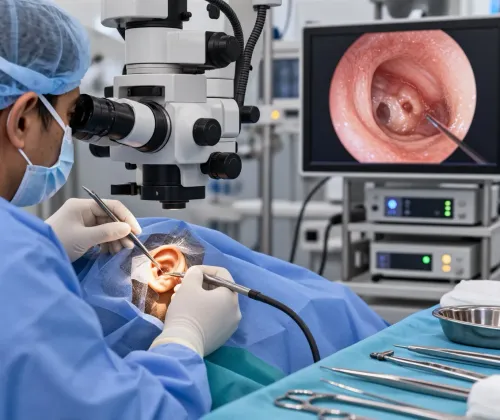
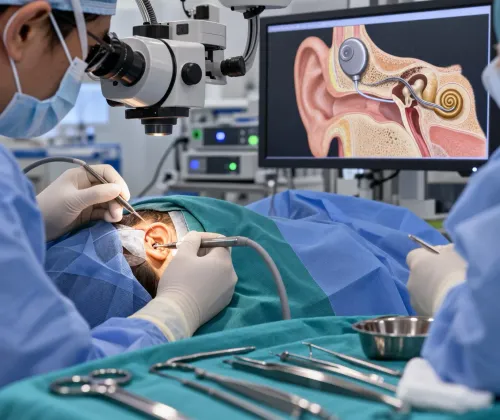
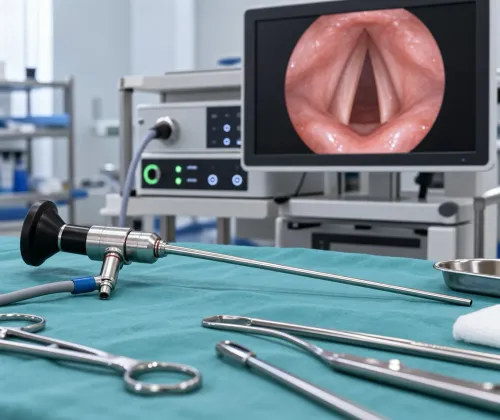
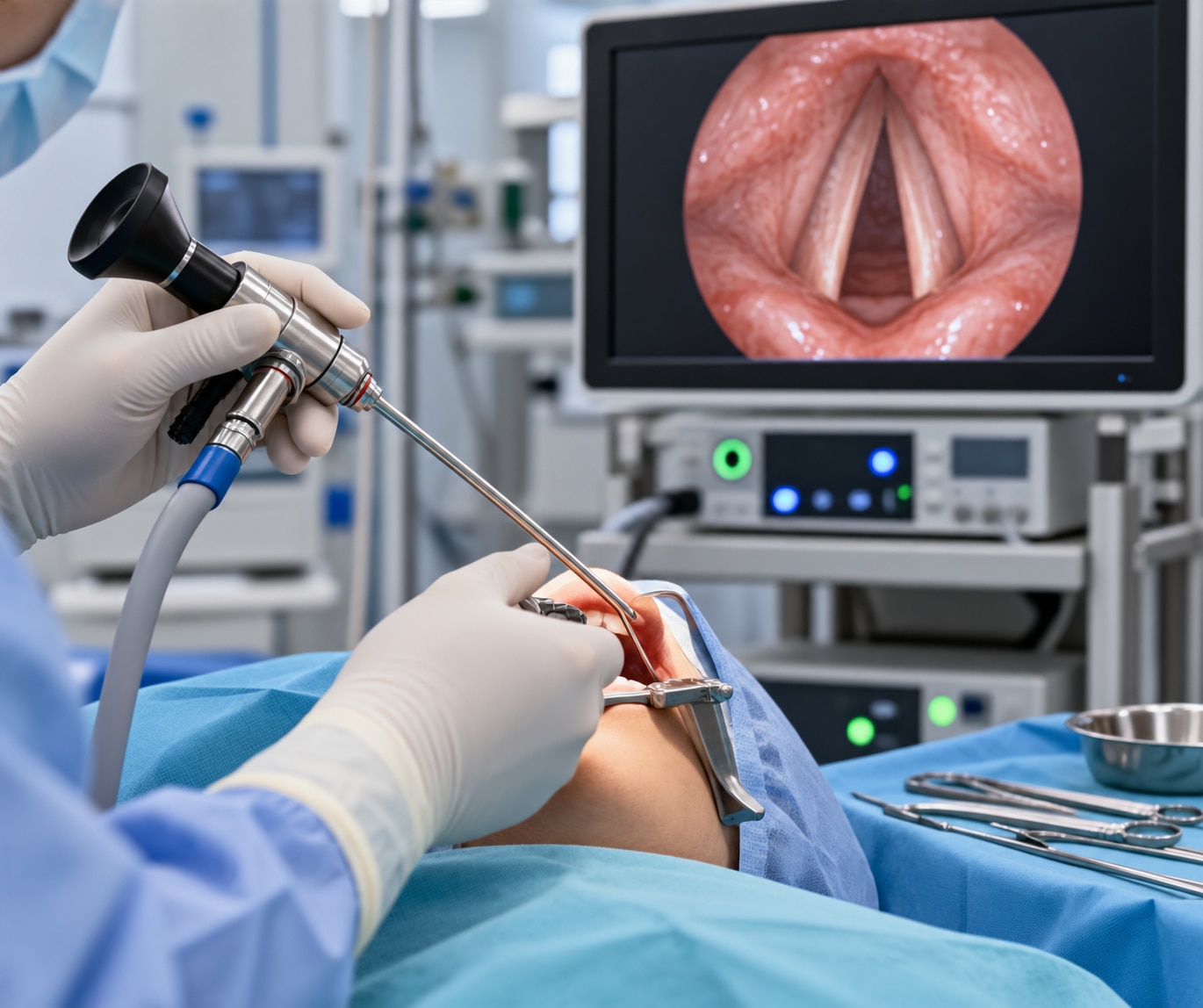
A 70° Hopkins rod examination uses a rigid, angled telescope with an optical lens and light source, passed through the mouth to enlarge the laryngeal view. The 70° angle helps inspect the tongue base, vallecula, epiglottis, arytenoids, false vocal folds, true vocal folds and parts of the hypopharynx.
You sit upright while the clinician steadies your tongue, applies throat anaesthetic when needed and guides the rod without passing it through the nose. The image appears on a monitor and may be photographed or recorded.
You may be asked to breathe, say “ee,” sniff or swallow, allowing assessment of vocal-fold movement, supraglottic squeeze, secretions and the laryngeal inlet.
A 70 degree Hopkins rod laryngoscopy in Bangalore can document:
- Nodules, polyps, cysts, papillomatous lesions and vocal-fold asymmetry
- Ulceration, leukoplakia, swelling, bleeding and reflux-related irritation
- Reduced or absent vocal-fold movement, pooled secretions, foreign bodies and suspicious masses
Hopkins rod laryngoscopy in Bangalore cannot show microscopic disease, tissue depth or every hidden surface. A suspicious appearance does not prove cancer; biopsy and histopathology establish the diagnosis.
| Examination | Best information | Main limitation |
|---|---|---|
| 70° Hopkins rod | Enlarged surface view and movement | Gagging; limited hidden areas |
| Flexible scope | Access through the nose during speech | Less magnified view |
| Stroboscopy | Mucosal wave and vibration timing | Not a biopsy or cancer diagnosis |
Which symptoms justify looking directly at the larynx?
Persistent hoarseness deserves direct laryngeal visualisation, especially when it continues after an apparent infection or keeps returning. Other triggers include throat pain or a foreign-body sensation despite a normal mouth, difficulty swallowing, chronic cough, noisy breathing, and a weak, breathy or changing voice.
A routine throat examination in Bangalore may inspect the tonsils, tongue, teeth, oral lining and neck yet miss the vocal folds, the larynx below the epiglottis, or a subtle lesion. That is why the laryngoscopy benefits in Bangalore include examining the voice box itself, not simply looking farther back in the mouth.
- Hoarseness after thyroid or neck surgery, prolonged intubation or suspected nerve injury: check vocal-fold movement.
- Coughing or choking during meals: look for laryngeal irritation, pooling secretions or movement problems.
- Stridor, worsening noisy breathing or difficulty getting air: visualise the airway urgently.
| Symptom | Why direct viewing helps | What a normal scope means |
|---|---|---|
| Persistent hoarseness | Shows nodules, polyps, cysts, ulceration, leukoplakia or suspicious growth | Visible structural problems are less likely at that examination; the voice problem may still need voice assessment |
| Swallowing pain or a stuck sensation | Examines the epiglottis, arytenoids and visible hypopharynx | It does not exclude reflux, a deeper lesion or a swallowing disorder |
| Reduced voice or breathiness | Compares vocal-fold movement and symmetry | It does not identify every nerve or muscle cause |
A visual impression cannot diagnose cancer; suspicious tissue requires biopsy and histopathology. Normal findings also do not explain neuropathic symptoms, muscle-tension dysphonia or intermittent airway narrowing, which may require follow-up, imaging or specialist testing.
How does Hopkins Rod laryngoscopy compare with other tests?
A rigid 70° examination gives an enlarged, direct view through the mouth, but it is not the best test for every question. Compare the options by comfort, access and what they can prove.
| Option | Comfort and visibility | Vibration, access and biopsy |
|---|---|---|
| 70° Hopkins rod | Awake, but the mouth insertion can trigger gagging. It gives a bright, enlarged view of the tongue base, epiglottis, arytenoids and vocal folds. | Phonation shows movement and gross function, but not the mucosal wave. It does not normally permit biopsy. |
| Flexible nasolaryngoscopy | A thin scope through the nose is often easier for patients who gag with oral examination. It follows the airway and shows the larynx during speech, breathing and swallowing. | Useful for dynamic movement and access around the nose and throat; ordinary viewing does not measure vocal-fold vibration precisely. Biopsy is not routine. |
| Mirror examination | Quick and inexpensive, but it requires a cooperative patient and offers a smaller, less complete view. | It cannot reliably inspect hidden or lower laryngeal areas, record detailed images or obtain tissue. |
| Videostroboscopy | Similar endoscopic tolerance, with specialised equipment and analysis. | Timed flashes assess vocal-fold vibration and mucosal wave, making it valuable for subtle lesions and professional voice users; it is not a biopsy test. |
| Direct laryngoscopy under anaesthesia | No discomfort during the procedure, but anaesthesia adds preparation and recovery. | Provides the widest controlled access for difficult areas, removal and biopsy. Histopathology, not appearance alone, establishes the diagnosis. |
These differences explain the laryngoscopy benefits in Bangalore: the appropriate test depends on whether you need a clear lesion view, movement assessment, vibration analysis or tissue diagnosis. Thus, Hopkins rod laryngoscopy in Bangalore is a focused visual examination, not a replacement for stroboscopy or operative laryngoscopy.
How should you prepare, and when is this the wrong first test?
Food and drink instructions depend on whether the examination is awake or involves sedation. Confirm them before your appointment: topical anaesthesia alone may not require fasting, while sedation or anaesthesia usually does. Do not stop blood thinners such as warfarin, apixaban, aspirin or clopidogrel unless the prescribing doctor tells you to.
- Tell the clinician about allergies, pregnancy, bleeding disorders, heart or lung disease, recent meals, loose teeth, recent mouth or throat surgery, and a strong gag reflex. These details affect the anaesthetic, positioning and choice of scope.
- Expect topical local anaesthetic in the mouth or throat. It can cause temporary numbness, coughing, gagging or throat discomfort, so avoid eating until normal sensation returns to prevent choking.
- Report breathing difficulty, noisy breathing, drooling or inability to swallow immediately. An airway emergency needs urgent airway assessment, not a routine awake examination.
- Ask whether another approach is better if you cannot tolerate instruments in the mouth. Flexible nasolaryngoscopy may be easier, while videostroboscopy suits detailed vocal-fold vibration assessment.
- A visible lesion does not prove cancer. Suspected tumour, leukoplakia or persistent ulceration generally requires biopsy, often through direct laryngoscopy under anaesthesia rather than office-based 70 degree Hopkins rod laryngoscopy in Bangalore.
A throat examination in Bangalore that inspects the mouth cannot replace laryngeal assessment when symptoms point to the voice box. Tell the service about your medical history before booking, especially if recent surgery or poor tolerance makes a rigid scope unsafe.
What should a useful laryngoscopy report contain in Bangalore?
A useful report should let you see whether the examination answered your specific question, not merely state “larynx normal.” The practical laryngoscopy benefits in bangalore depend on a traceable record of what was inspected and what happens next.
1. Subsites examined: tongue base, vallecula, epiglottis, arytenoids, false and true vocal folds, laryngeal inlet, and visible hypopharynx.
2. Vocal-fold function: right and left movement, symmetry, closure during phonation, and any reduced mobility or supraglottic compression.
3. Airway adequacy: the size and openness of the laryngeal inlet, with swelling, narrowing or obstruction described clearly.
4. Secretions: pooling, aspiration-related residue, blood or thick mucus, including its location.
5. Lesions: exact site, side, size and appearance of nodules, polyps, cysts, ulceration, leukoplakia, papillomatous growths or a suspicious mass. A visual impression cannot diagnose cancer; suspicious tissue needs biopsy and histopathology.
6. Evidence: labelled photographs or video linked to the written interpretation. Images support comparison but do not replace clinical judgment.
7. Next step: observation, voice therapy, medication review, repeat scope, videostroboscopy, imaging, or direct laryngoscopy and biopsy.
For Hopkins rod laryngoscopy in bangalore, a service such as Dr. Sohini's ENT Care - Empathy meets Expertise can help connect these findings with follow-up or further testing rather than leaving an abnormal report unexplained.
Related service
OPD Consultation and Procedures Laryngoscopy with 70° Hopkins Rod Explore advanced laryngeal care with Dr. Sohini Chakrabarti's expertise in Laryngology, featuring the cutting-edge 70° Hopkins Rod technology. View service → |
Frequently asked questions
What does a 70° Hopkins Rod examination actually show?
It provides an enlarged view of the tongue base, vallecula, epiglottis, arytenoids, false vocal folds, true vocal folds and parts of the hypopharynx through the mouth.
Which symptoms justify looking directly at the larynx?
Persistent hoarseness, swallowing difficulty, throat pain, a throat lump sensation, noisy breathing, recurrent aspiration, unexplained cough or coughing blood can justify direct laryngeal examination.
How does Hopkins Rod laryngoscopy compare with other tests?
A rigid 70° rod gives a bright, magnified view, while flexible nasolaryngoscopy is usually better tolerated and allows assessment during speech and breathing. Stroboscopy assesses vocal-fold vibration, and imaging evaluates deeper structures outside the surface view.
How should you prepare, and when is this the wrong first test?
Follow the clinic's instructions about eating, drinking and local anaesthetic. Flexible examination is often a better first choice when gagging is strong, nasal access is easier, or dynamic voice assessment matters. Urgent airway symptoms need immediate medical evaluation.
What should a useful laryngoscopy report contain in Bangalore?
The report should name the examination method, document each visible laryngeal subsite, describe vocal-fold movement and mucosal abnormalities, record limitations, include images when available, and state the next step.
Keywords